How Tradoshi helps traders spot the habits behind their losses
A trading journal that connects broker history to a trader’s own rules, with SnapTrade powering supported brokerage connections.
· SnapTrade
Your brokerage account shows which trades you made and how much money you gained or lost. But it doesn't tell you whether you're repeating the same mistakes.
That’s the gap Tradoshi is trying to close. It helps traders review their trading history, spot patterns, and see when they haven't followed their own rules.
This trading journal is built around behavior, not just profit and loss. Instead of asking traders to maintain a spreadsheet, it brings their trades into one place and helps them look for patterns in how they make decisions.
A trading journal that checks the plan, not just the P&L
Tradoshi is built for active retail traders, including day traders, swing traders, and prop-firm challenge traders. It supports workflows involving forex, futures, stocks, and crypto, and is available in English, French, Spanish, and Portuguese.
A trader can connect a supported brokerage account or import a statement. Tradoshi then breaks trade history down by hour, day, setup, and instrument, with fees included in its journal, according to the team.
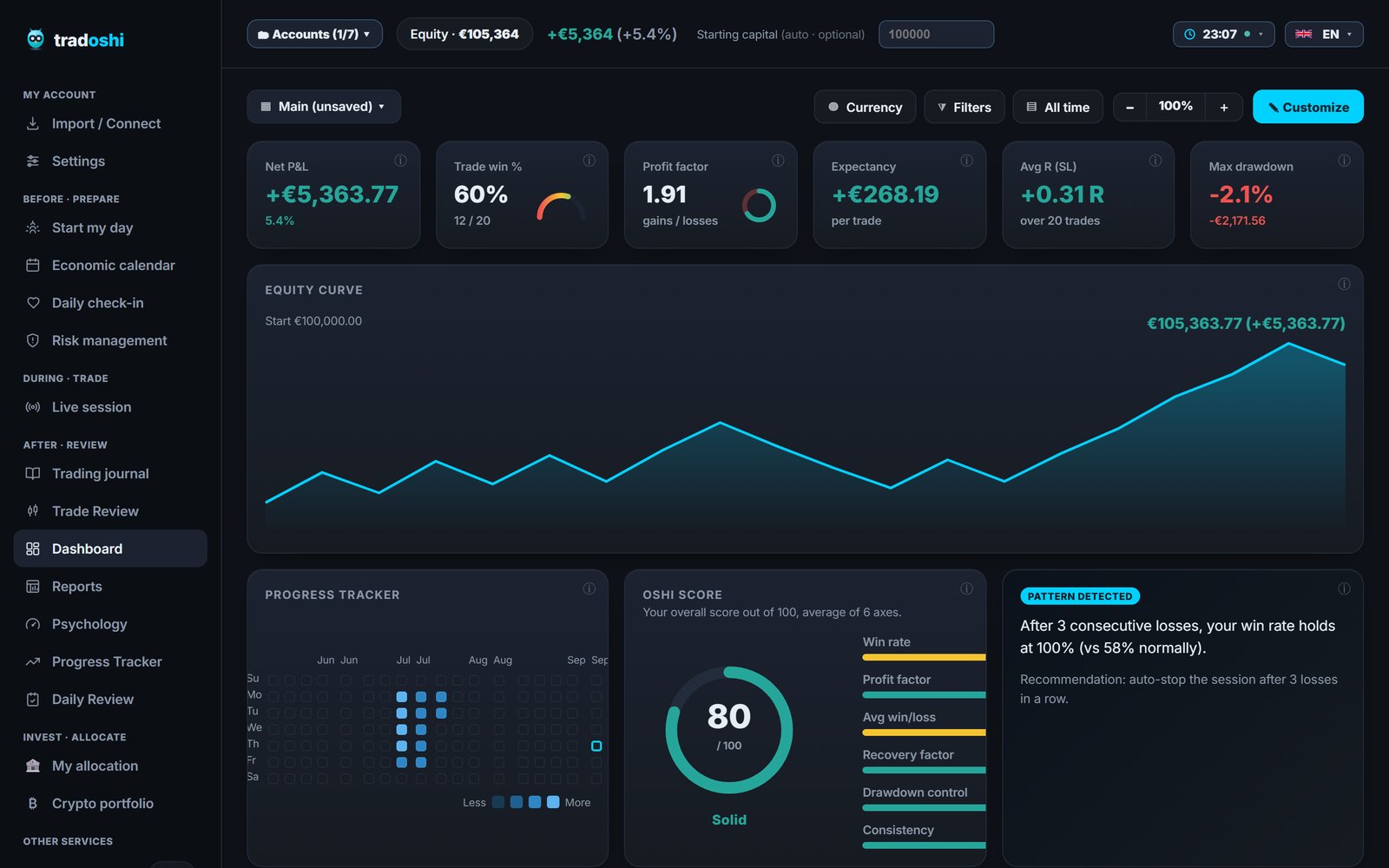
The point is to give a trader something specific to examine: Do losses cluster at a particular hour? Are trades being taken after a loss? Is position sizing drifting from the written plan?
“Most traders already know their strategy. What they cannot see is how their own behaviour costs them money. Tradoshi shows it from the trades themselves, without a spreadsheet.”
What using Tradoshi looks like
Tradoshi has two connected parts: a journal that reviews past decisions and a pre-trade check that brings the trader’s plan into the next decision.
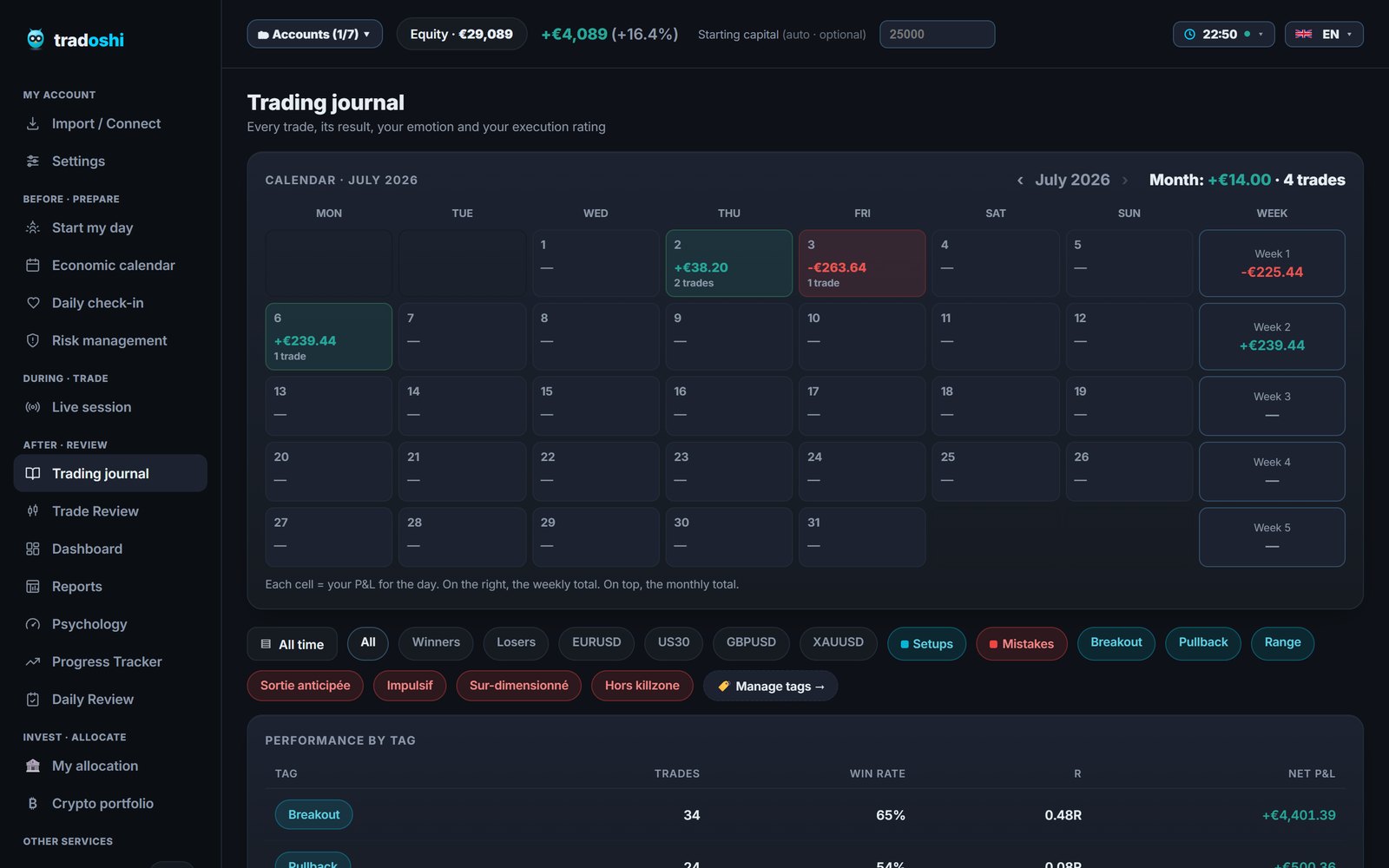
After importing activity, the trader can review results by time, setup, or instrument. Tradoshi also offers a discipline score intended to show how consistently a trader follows their own rules.
Oshi, its AI coach, compares trades against the trader’s written plan and flags rules the trader may have broken. Before a new trade, the pre-trade check asks questions drawn from that same plan.
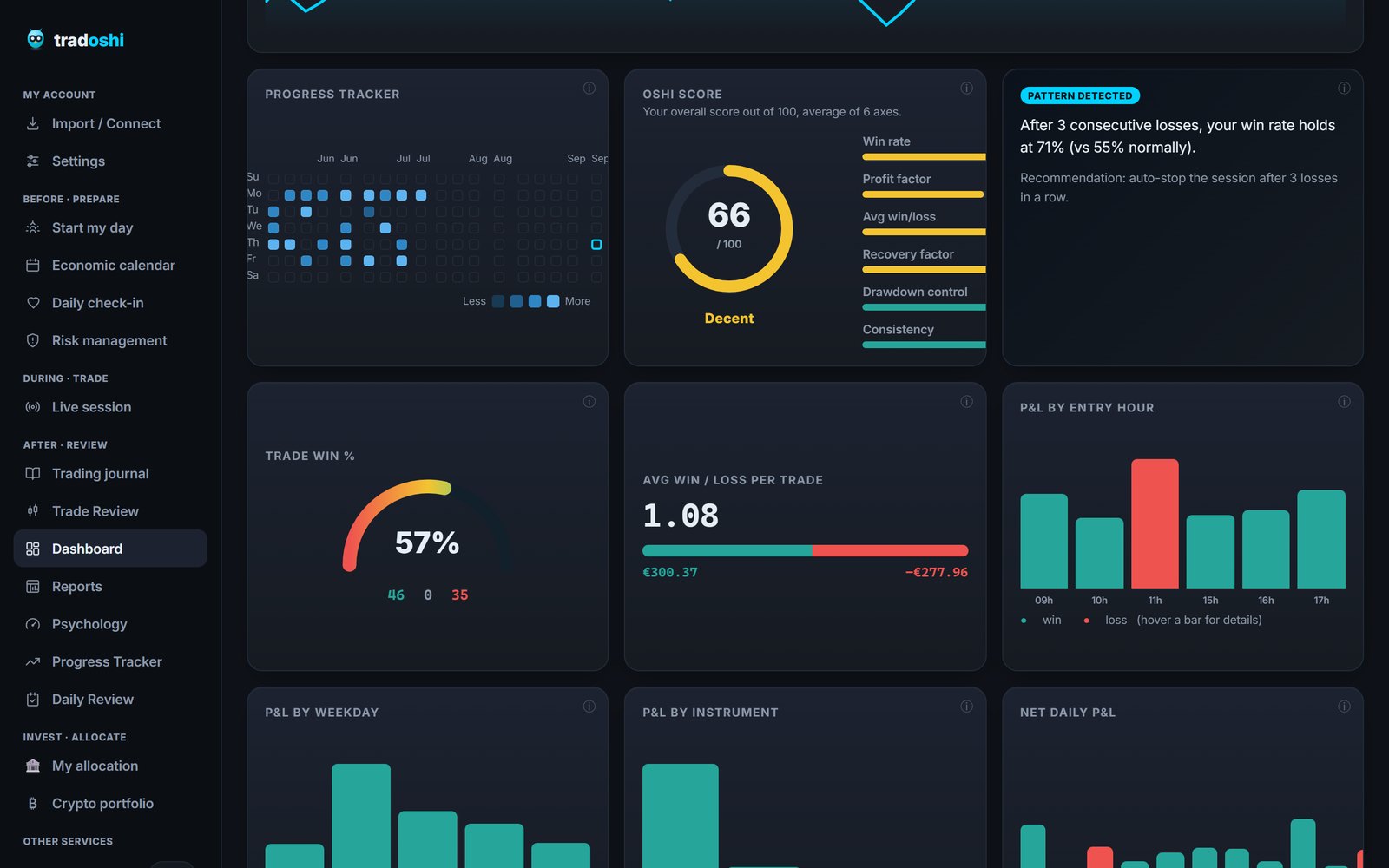
For example, if someone’s plan says not to trade after a loss, the journal can help them examine whether they followed it. The feature is meant to make patterns easier to see, not to predict markets, guarantee better returns, or give investment advice.
Prop-firm challenge traders can also track their challenge rules within the journal. The product does not place trades or act as a broker.
How brokerage connections fit in
A journal only helps when people actually keep it up to date. That’s harder when each trading session ends with another manual export or spreadsheet update. For Tradoshi, a UK-based company serving traders internationally, connecting customers to US brokerages is another challenge. The team says SnapTrade gives its journal access to supported US brokerage data without having to build a separate integration for each broker.
Tradoshi uses SnapTrade’s Connection Portal and account-data APIs for read-only connections to supported brokerage accounts. The user chooses a broker inside Tradoshi, authorizes the connection through SnapTrade, and can then import account and transaction history into the journal. Tradoshi says its connection is read-only and that the app cannot place orders.
According to Tradoshi’s detailed submission, its SnapTrade-powered connections include Charles Schwab, Fidelity, Robinhood, E*TRADE, and Webull. Connection availability and permissions can vary by brokerage. Tradoshi also reports connections to more than 2,000 brokers and prop firms across its wider product, through methods beyond SnapTrade.
Tradoshi also shared its own announcement about connecting Charles Schwab and Robinhood through SnapTrade.
Tradoshi reported that traders who link their own brokerage accounts come back about three times as often as traders who only use demo data. The team sees this as evidence that easier brokerage connections may encourage traders to keep using the journal.
“Some of the largest US brokers do not open their API to trading journals. SnapTrade lets our users connect them in a minute, read-only, without sharing their password with us.”
Who should try it?
Tradoshi is worth a look for traders who want to review their own decision-making, especially those who keep abandoning manual journals. It may also be useful for prop-firm challenge traders who want to keep their rules and trade history in the same place.
The team reported more than 1,000 sign-ups since launching in July 2026. An Android app is available on Google Play; Tradoshi says it does not yet have an iOS app.
To try it, visit https://tradoshi.com/en/. Tradoshi says new users can try the app free for 14 days. For a supported brokerage connection, open Import / Connect, choose + Add an account, enter the broker’s name, and select Connect via SnapTrade.
Building with SnapTrade?
Tradoshi built the journal, behavior analysis, and coaching experience. SnapTrade provides the brokerage connectivity and account-data access underneath supported connections. If you’re building an investing app using SnapTrade, you can apply to be featured at https://snaptrade.com/partners/app-spotlight.